Partial notes
Where this page refers to a concrete token, it assumes the AIP-20 fungible token standard. The partial-note primitive (UintNote / PartialUintNote) is token-agnostic; AIP-20 is one standard built on top of it.
What are partial notes?
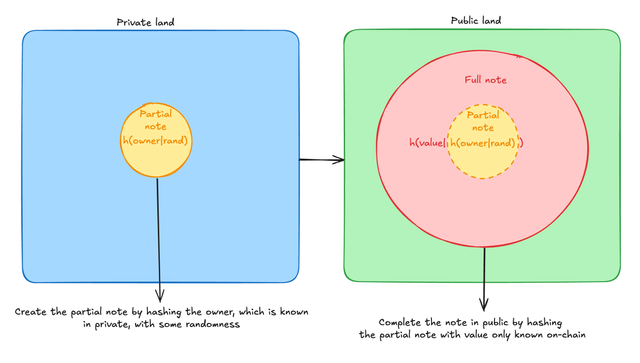
Partial notes are notes created with incomplete data, usually during private execution, which can be completed with additional information that becomes available later, usually during public execution.
Let's say, for example, we have a UintNote:
#[derive(Deserialize, Eq, Serialize, Packable)]
#[custom_note]
pub struct UintNote {
    /// The number stored in the note.
    pub value: u128,
}
Source code: noir-projects/aztec-nr/uint-note/src/uint_note.nr#L30-L37
The UintNote struct itself only contains the value field. Additional fields including owner, randomness, and storage_slot are passed as parameters during note hash computation.
When creating the note locally during private execution, the owner and storage_slot are known, but the value potentially is not (e.g., it depends on some onchain dynamic variable). First, a partial note can be created during private execution that commits to the owner and randomness, and then the note is "completed" to create a full note by later adding the storage_slot and value fields, usually during public execution.
Use cases
Partial notes are useful when part of the note struct is a value that depends on dynamic, public onchain data that isn't available during private execution, such as:
- AMM swap prices
- Current gas prices
- Time-dependent interest accrual
They are also useful as payment endpoints: a recipient can create a partial note ahead of time and share the commitment with prospective senders. Senders later complete the partial note to pay the recipient, with no action needed from the recipient at payment time. See partial notes as payment endpoints for the full design.
The completer
A partial note is finalized by a later completion step that supplies the public fields (storage_slot and value). At that point its private preimage (owner and randomness) is not re-derived or re-checked, and the partial note itself is just a Field that can be copied and shared freely. If anyone holding it could complete it, they could insert a note with an arbitrary, unbacked value into the note hash tree, or complete the note at the wrong time or with the wrong values.
To prevent this, the creator designates a completer at creation time. During the constrained private execution that creates the partial note, the contract records a validity commitment H(partial_commitment, completer) in the nullifier tree. Completion recomputes this commitment and asserts it exists, using its presence as proof that a legitimate, constrained execution created the partial note and authorized this specific completer to supply the public values and finalize it.
With AIP-20, the completer is chosen explicitly when calling initialize_transfer_commitment; completion (transfer_private_to_commitment / transfer_public_to_commitment) binds the completer to the caller's msg_sender and debits a separately authorized from account.
For UintNote, the fields split cleanly across the two phases:
| Field | Fixed at | How |
|---|---|---|
owner | Partial note creation (private) | Committed in partial_commitment = H(owner, randomness) |
randomness | Partial note creation (private) | Same commitment; fresh per note, blinds the owner |
completer | Partial note creation (private) | Bound in the validity commitment H(partial_commitment, completer); not part of the note hash |
storage_slot | Completion (public or private) | Hashed into note_hash = H(storage_slot, partial_commitment, value) |
value | Completion (public or private) | Same hash; supplied by the completer's call |
(storage_slot is typically known during private execution too; it is just not bound into the note hash until completion.)
The creator fixes who gets paid (owner) and who may finalize (completer); the completer later fixes how much (value). Funds therefore flow from the completing side to the note's owner: in AIP-20, completion debits the authorized from account (the completer itself, or a payer who authorized it) and credits the owner chosen by the creator.
Single-use semantics
Each partial note is intended to be completed exactly once. The protocol does not enforce this directly: completion checks that a validity commitment exists in the nullifier tree but does not consume it, so a partial note can technically be completed more than once. However, reuse is unsafe for two independent reasons:
- Privacy. The completion log is tagged by
H(partial_commitment). Two completions of the same partial note emit logs with the same tag, which publicly links those completions as paying the same recipient. - Discovery. The recipient's Private eXecution Environment (PXE) treats the partial note as pending until the first matching completion log is found. After the first match, the pending entry is removed. A second completion against the same commitment may not be discovered by the recipient's wallet, so the funds are effectively lost.
This is why an AIP-20 commitment should be completed only once. A second transfer_private_to_commitment (or transfer_public_to_commitment) against the same commitment is not found by the recipient's log processing on the second pass, so the amount is most likely lost.
The takeaway: treat each partial note as a one-shot object. To accept multiple payments, create multiple partial notes.
Completion in public and private contexts
PartialUintNote supports completion in two contexts:
completeruns in a public function (AIP-20'stransfer_public_to_commitment). The storage slot and value are emitted in a public log tagged by the partial note's commitment. Anyone observing the chain learns the amount.complete_from_privateruns in a private function (AIP-20'stransfer_private_to_commitment). The same storage slot and value are emitted in a private log with the same tag. The payload is plaintext, but it is only discoverable by a party that can derive the tag, and the tag derives from the partial note's commitment.
For private→private completion, the privacy of the amount depends on whether the partial note's commitment itself is held secret. If the commitment is published publicly (e.g., in an onchain registry), anyone can derive the tag and read the amount from the private log payload. If the commitment is shared only with prospective senders, the amount stays hidden from outside observers.
One additional protocol constraint: complete_from_private requires the validity commitment to be settled in a prior transaction. A partial note cannot be both created and completed in the same private transaction. The public completion path has no such restriction.
Implementation
All notes in Aztec use the partial note format internally. This ensures that notes produce identical note hashes regardless of whether they were created as complete notes (with all fields known in private) or as partial notes (completed later in public). By having all notes follow the same two-phase hash commitment process, the protocol maintains consistency and allows notes created through different flows to behave identically.
Note structure example
The UintNote struct contains only the value field:
#[derive(Deserialize, Eq, Serialize, Packable)]
#[custom_note]
pub struct UintNote {
    /// The number stored in the note.
    pub value: u128,
}
Source code: noir-projects/aztec-nr/uint-note/src/uint_note.nr#L30-L37
Two-phase commitment process
Phase 1: partial commitment (private execution)
The private fields (owner and randomness) are committed during local, private execution:
fn compute_partial_commitment(owner: AztecAddress, randomness: Field) -> Field {
    poseidon2_hash_with_separator(
        [owner.to_field(), randomness],
        DOM_SEP__PARTIAL_NOTE_COMMITMENT,
    )
}
Source code: noir-projects/aztec-nr/uint-note/src/uint_note.nr#L145-L152
This creates a partial note commitment:
partial_commitment = H(owner, randomness)
Phase 2: note completion (public execution)
The note is completed by hashing the partial commitment with the public value:
fn compute_complete_note_hash(self, storage_slot: Field, value: u128) -> Field {
    compute_note_hash(storage_slot, [self.commitment, value.to_field()])
}
Source code: noir-projects/aztec-nr/uint-note/src/uint_note.nr#L257-L261
The resulting structure is a nested commitment:
note_hash = H(storage_slot, H(owner, randomness), value)
          = H(storage_slot, partial_commitment, value)
Universal note format
All notes in Aztec use the partial note format internally, even when all data is known during private execution. This ensures consistent note hash computation regardless of how the note was created.
When a note is created with all fields known (including owner, storage_slot, randomness, and value):
- A partial commitment is computed from the private fields (
owner,randomness) - The partial commitment is immediately completed with the
storage_slotandvaluefields
fn compute_note_hash(self, owner: AztecAddress, storage_slot: Field, randomness: Field) -> Field {
    // Partial notes can be implemented by having the note hash be either the result of multiscalar multiplication
    // (MSM), or two rounds of poseidon. MSM results in more constraints and is only required when multiple
    // variants of partial notes are supported. Because UintNote has just one variant (where the value is public),
    // we use poseidon instead.

    // We must compute the same note hash as would be produced by a partial note created and completed with the
    // same values, so that notes all behave the same way regardless of how they were created. To achieve this, we
    // perform both steps of the partial note computation.

    // First we create the partial note from a commitment to the private content.
    let partial_note = PartialUintNote { commitment: compute_partial_commitment(owner, randomness) };

    // Then compute the completion note hash. In a real partial note this step would be performed in public.
    partial_note.compute_complete_note_hash(storage_slot, self.value)
}
Source code: noir-projects/aztec-nr/uint-note/src/uint_note.nr#L40-L57
This two-step process ensures that notes with identical field values produce identical note hashes, regardless of whether they were created as partial notes or complete notes.
Partial notes in practice
To understand how to use partial notes in practice, this AMM contract uses partial notes to initiate and complete the swap of token1 to token2. Since the exchange rate is onchain, it cannot be known ahead of time while executing in private so a full note cannot be created. Instead, a partial note is created for the owner swapping the tokens. This partial note is then completed during public execution once the exchange rate can be read.
For a different application of the same primitive, where the partial note represents an offer to be paid rather than a deferred DeFi settlement, see partial notes as payment endpoints.